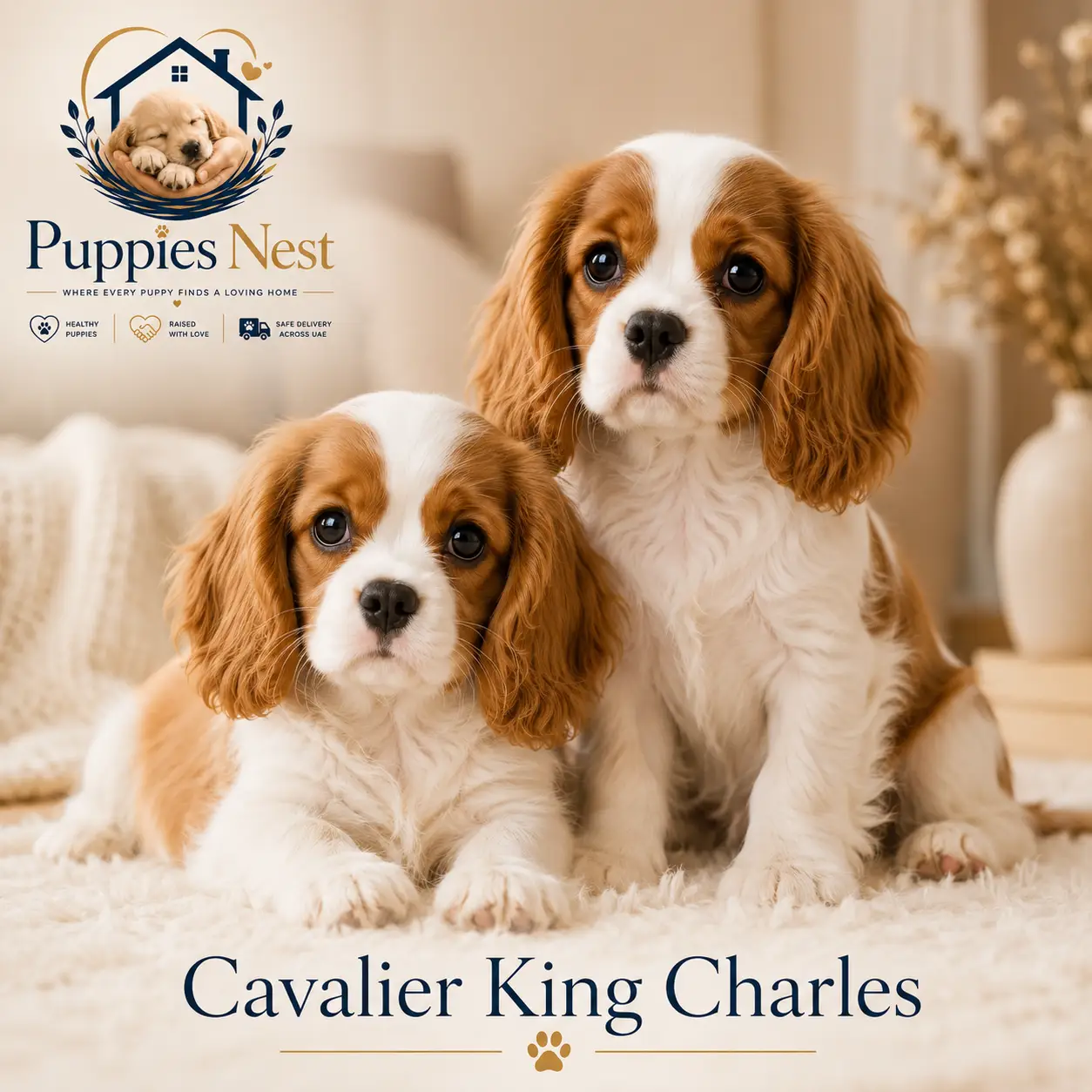
Cavalier King Charles Puppy for Sale in UAE
8,000 د.إ
| Gender | Female, Male |
|---|---|
| Size | Large, Medium, Small, Tea Cup |
| Age | 12 Weeks |
If you are looking for a Cavalier King Charles Spaniel for sale, the Cavalier King Charles Spaniel puppy available from Puppies Nest can be a beautiful choice for families searching for a friendly and affectionate companion. A Cavalier King Charles puppy is known for its gentle personality, expressive eyes, soft feathered coat, and strong connection with people, while the adult Cavalier King Charles Spaniel dog is typically a social and adaptable companion that enjoys being part of everyday family life. At Puppies Nest, customers can ask about the available puppy, its specifications, vaccination certificate, current availability, and delivery services within the UAE before completing their purchase.
Meet Our Cavalier King Charles Spaniel Puppy
The Cavalier King Charles Spaniel available from Puppies Nest is offered as a companion puppy for a family looking for a loving dog to become part of its everyday life.
This is not simply about choosing a beautiful breed.
When bringing home a puppy, you are welcoming a young dog that will need time, patience, training, appropriate food, veterinary care, grooming, exercise, and plenty of positive interaction. A Cavalier can be particularly rewarding because it generally enjoys staying close to its people.
Your puppy may eventually become the dog that:
- Follows you around the house
- Waits for you near the door
- Sits beside you while you work
- Plays with its favorite toys
- Greets you when you return
- Sleeps near its family
- Learns your daily routine
- Enjoys short walks with you
The first few weeks are therefore extremely important.
The way you introduce your puppy to your home, food, training, grooming, and family life can help create good habits for the future.
Cavalier King Charles Spaniel Puppy Specifications
Before purchasing your new puppy, it is important to understand the available specifications.
| Specification | Details |
|---|---|
| Breed | Cavalier King Charles Spaniel |
| Type | Companion Dog |
| Size | Small |
| Age | According to the available puppy |
| Gender | Male or Female according to availability |
| Coat | Long, soft, and feathered |
| Personality | Affectionate, friendly, playful, and social |
| Lifestyle | Indoor companion |
| Suitable For | Families, couples, singles, and apartment living |
| Vaccination | Vaccination certificate provided |
| Delivery | Delivery services available within the UAE |
| Ordering | Contact Puppies Nest through WhatsApp |
The exact characteristics of the available puppy can change according to current availability.
For the latest information, customers can contact Puppies Nest directly through WhatsApp.
What Makes Our Cavalier King Charles Puppy Special?
The Cavalier King Charles Spaniel is more than a small, attractive dog. It is a companion breed, which means its relationship with people is one of its most important characteristics.
A Cavalier often wants to be involved in everyday family life. It may sit beside you while you work, follow you from one room to another, become excited when you pick up its leash, or wait near the door when it hears familiar sounds.
This people-oriented personality is one of the main reasons families choose the breed.
| What Your Cavalier May Do | What It Shows |
|---|---|
| Follow you around the house | Enjoys staying close to family |
| Sit beside you | Seeks companionship |
| Gets excited when you pick up the leash | Associates the leash with enjoyable walks |
| Recognize familiar sounds | Learns household routines |
| Develop favorite toys | Shows individual preferences |
| Chooses favorite sleeping spots | Becomes comfortable with its environment |
| Joins family activities | Enjoys being part of everyday life |
Cavalier King Charles Puppy: Appearance
A young Cavalier King Charles puppy already has many of the characteristics that make the breed recognizable.
You can expect features such as large expressive eyes, long feathered ears, a soft facial expression, a compact body, and a silky coat.
As the puppy grows, its coat and feathering will continue to develop, so its appearance may change during the first months of life.
| Feature | What You Can Expect |
|---|---|
| Eyes | Large and expressive |
| Ears | Long and feathered |
| Expression | Soft and gentle |
| Body | Compact and balanced |
| Coat | Soft and silky |
| Legs | Feathered as the coat develops |
| Tail | Feathered |
| Overall Appearance | Small, elegant, and recognizable as a spaniel |
Cavalier King Charles Spaniel Dog: What Will Your Puppy Become?
When you bring home a puppy, it is helpful to think beyond the first few weeks.
Your Cavalier King Charles Spaniel dog will eventually become an adult companion with its own personality, routines, preferences, and habits.
The care you provide during puppyhood can help establish good habits for adult life.
| Puppyhood | Adult Life |
|---|---|
| Learning basic commands | Continuing obedience and good manners |
| Establishing bathroom habits | Maintaining a reliable routine |
| Learning to accept grooming | Regular coat maintenance |
| Learning to walk on a leash | Enjoying regular walks |
| Socializing with people and suitable dogs | Maintaining positive social behavior |
| Learning household routines | Becoming comfortable with everyday family life |
| Developing eating habits | Maintaining balanced nutrition and healthy weight |
An adult Cavalier will still need exercise, grooming, training, good nutrition, veterinary care, social interaction, mental stimulation, and family companionship.
Bringing Your Cavalier King Charles Puppy Home
The first day should be calm.
Your puppy is entering an unfamiliar environment, and almost everything may feel new.
It may encounter:
- New smells
- New sounds
- New people
- New furniture
- New food bowls
- A new sleeping area
- A new bathroom location
- A completely different daily routine
Do not expect your puppy to understand everything immediately.
Give it time to explore and learn.
Prepare Your Home Before Arrival
Before your Cavalier King Charles Spaniel puppy arrives, prepare the basic supplies it will need.
| Area | What to Prepare |
|---|---|
| Sleeping Area | Comfortable bed, blanket, and a quiet place to rest |
| Feeding Area | Separate food and water bowls |
| Food | The puppy’s current food, based on information from Puppies Nest |
| Toys | Puppy-safe toys appropriate for its size |
| Bathroom Area | A clearly defined bathroom location |
| Grooming | Soft brush and basic grooming supplies |
| Cleaning | Pet-safe cleaning products for normal puppy accidents |
Puppy-Proof Your Home
A young Cavalier can be surprisingly curious.
Before bringing your puppy home, look around from the puppy’s perspective and remove anything it could chew, swallow, or knock over.
| Potential Hazard | What to Check |
|---|---|
| Electrical Wires | Keep cables secured and out of reach. |
| Small Objects | Remove anything that could be swallowed. |
| Cleaning Products | Store them in secure locations. |
| Medicines | Keep all medication inaccessible. |
| Toxic Plants | Remove unsafe plants from areas the puppy can access. |
| Balconies | Make sure openings are properly secured. |
| Windows | Prevent unsafe access or falls. |
| Sharp Objects | Keep them away from the puppy. |
| Human Food | Store unsafe foods securely. |
| Children’s Toys | Keep small pieces away from the puppy. |
A puppy may investigate objects that an adult dog would completely ignore.
The First Day With Your Cavalier King Charles Puppy
The first day does not need to be complicated.
Focus on helping your puppy understand that its new home is safe.
| Step | What to Do |
|---|---|
| 1. Bathroom | Allow the puppy to use its designated bathroom area. |
| 2. Water | Show the puppy where its fresh water is available. |
| 3. Exploration | Allow quiet exploration of a limited area. |
| 4. Family Introduction | Introduce family members gradually. |
| 5. Rest | Allow the puppy to sleep whenever it needs to. |
| 6. Routine | Begin establishing predictable meal, bathroom, play, and sleep times. |
Do not overwhelm the puppy by immediately introducing the entire house, large groups of visitors, or long periods of activity.
The First Night
The first night may be challenging for some puppies.
The puppy has just left a familiar environment and may be experiencing a completely different routine.
It may:
- Whine
- Cry
- Wake during the night
- Look for company
- Move around restlessly
These behaviors can occur during the adjustment period.
Create a comfortable sleeping environment and keep the bedtime routine predictable.
Avoid turning every period of whining into an exciting play session, because this can unintentionally teach the puppy that crying brings extra attention and activity.
How to Help Your Puppy Feel Safe
Predictability can make the transition easier.
Then repeat an appropriate version of this pattern throughout the day.
| Routine | What the Puppy Learns |
|---|---|
| Wake Up Bathroom |
Where to go after sleeping |
| Food Rest |
A predictable meal routine |
| Play Training |
Appropriate ways to interact |
| Training Rest |
Short learning sessions followed by downtime |
| Evening Bathroom Sleep |
A consistent bedtime routine |
Over time, your puppy begins to understand what normally happens next.
The First Week With Your Cavalier King Charles Puppy
The first week should focus primarily on adjustment and establishing basic routines.
You do not need to teach everything immediately.
| First-Week Priority | Goal |
|---|---|
| Eating | Help the puppy maintain a consistent feeding routine. |
| Drinking | Keep fresh water available. |
| Sleeping | Establish a comfortable and quiet sleeping area. |
| Name Recognition | Begin teaching the puppy to respond to its name. |
| Bathroom Training | Start a consistent bathroom routine. |
| Family Interaction | Allow the puppy to become comfortable with household members. |
| Sleeping Area | Help the puppy understand where it should rest. |
| Gentle Handling | Gradually introduce handling of paws, ears, and coat. |
| Basic Training | Introduce very short, positive training sessions. |
Small progress is still progress.
A puppy that learns one behavior calmly is making more useful progress than a puppy that is overwhelmed by too much training at once.
Cavalier King Charles Puppy Feeding Schedule
Nutrition is particularly important during puppyhood.
A young Cavalier King Charles puppy needs complete and balanced nutrition appropriate for growth.
The feeding routine should be consistent, but the exact number of meals and portion size should depend on the puppy’s age, weight, food, activity level, growth, and veterinary recommendations.
A sample routine can look like this:
| Time | Activity |
|---|---|
| 7:00 AM | Breakfast |
| 10:30 AM | Small meal |
| 2:00 PM | Meal |
| 6:00 PM | Dinner |
| Evening | Fresh water, bathroom routine, and quiet time |
This is a sample schedule, not a fixed feeding prescription for every puppy.
The puppy’s food packaging and veterinary guidance should be used to determine the appropriate portion size.
Cavalier King Charles Puppy: First Month Goals
During the first month, the focus should gradually move from simply settling into the home toward building useful everyday habits.
| Area | First-Month Goal |
|---|---|
| Name | Responds to its name in calm situations |
| Bathroom | Begins developing a consistent bathroom routine |
| Feeding | Follows a predictable meal schedule |
| Sleeping | Becomes familiar with its sleeping area |
| Handling | Becomes comfortable with gentle handling |
| Grooming | Begins accepting short brushing sessions |
| Training | Starts learning simple commands |
| Leash | Begins becoming comfortable with a harness and leash |
| Socialization | Experiences safe, positive new situations gradually |
| Family Life | Becomes familiar with normal household routines |
The first month is not about creating a perfectly trained dog.
It is about giving your Cavalier King Charles puppy a safe beginning, predictable routines, positive experiences, and the foundation it needs to grow into a confident family companion.
Week-by-Week Feeding Plan
Week 1: Keep the Existing Food
When your Cavalier King Charles puppy arrives, avoid making unnecessary changes immediately. Ask Puppies Nest what food the puppy has been eating and, when appropriate, continue with the same food during the initial adjustment period.
The puppy is already experiencing many changes by moving to a new home. Keeping its diet stable can make the transition easier.
| What to Check | Why It Matters |
|---|---|
| Current food | Helps avoid an unnecessary sudden diet change |
| Feeding times | Creates a predictable routine |
| Portion size | Helps prevent overfeeding |
| Water intake | Supports normal hydration |
| Appetite | Can help you notice changes early |
Week 2: Establish Consistent Meal Times
Once the puppy becomes more comfortable, establish consistent meal times.
| Part of the Day | Example |
|---|---|
| Morning | Breakfast |
| Midday | Meal |
| Afternoon/Evening | Meal |
| Evening | Water and bathroom routine |
| Consistency helps your puppy understand its daily routine. |
Week 3: Monitor Appetite and Weight
By the third week, you should have a better understanding of your puppy’s normal eating habits.
| What to Monitor | What to Look For |
|---|---|
| Appetite | Normal interest in meals |
| Stool | Consistent stool without persistent digestive problems |
| Energy | Normal puppy activity |
| Weight | Appropriate growth |
| Water intake | Normal drinking behavior |
| If you notice a significant or persistent change, contact your veterinarian. |
Week 4: Maintain the Routine
Once your puppy has adjusted, continue the established feeding schedule.
Avoid constantly changing foods or adding table scraps simply because the puppy asks for them. A consistent diet is generally easier to manage.
What Should a Cavalier King Charles Puppy Eat?
Choose complete and balanced puppy food appropriate for your puppy’s age, size, and growth stage.
| Nutrient | Why It Matters |
|---|---|
| Protein | Supports muscles and normal growth |
| Healthy fats | Provides energy and supports development |
| Carbohydrates | Can provide energy when included in a balanced diet |
| Vitamins | Support normal body functions |
| Minerals | Support bones and other body systems |
| Essential fatty acids | Support skin, coat, and development |
| The goal is to provide appropriate nutrition without encouraging excessive weight gain. |
How Much Food Does a Cavalier Need?
There is no universal portion that works for every Cavalier puppy.
| Factor | How It Can Affect Feeding |
|---|---|
| Age | Growing puppies have different needs from adults |
| Weight | Helps determine appropriate portions |
| Activity | More active dogs may require different calorie intake |
| Growth | Puppies need nutrition appropriate for development |
| Food formulation | Calorie density differs between foods |
| Individual health | Some dogs may require specific dietary adjustments |
| Use the manufacturer’s feeding recommendations as a starting point and ask your veterinarian to help adjust portions according to your puppy’s body condition and development. |
Do Not Change Food Suddenly
If you decide to change your puppy’s food, make the transition gradually.
| Sudden Food Change May Be Associated With | Possible Result |
|---|---|
| Rapid diet change | Digestive upset |
| New ingredients | Gas or loose stool |
| Large dietary change | Reduced appetite |
| Food intolerance | Vomiting or diarrhea |
| A gradual transition gives the digestive system time to adjust. |
Treats for Your Cavalier King Charles Puppy
Treats can be useful during training, but your puppy does not need large rewards.
| Treat Option | How to Use It |
|---|---|
| Small puppy treats | Use tiny pieces during training |
| Regular puppy food | Reserve part of the daily food for rewards |
| Approved dog treats | Choose options appropriate for the puppy’s age and size |
| Keep treats within the puppy’s overall daily calorie needs. |
Foods Your Cavalier Should Never Eat
Keep potentially dangerous foods away from your puppy.
| Food | Why It Should Be Avoided |
|---|---|
| Chocolate | Can be toxic to dogs |
| Grapes | Can cause serious toxicity |
| Raisins | Can cause serious toxicity |
| Onions | Can damage red blood cells |
| Garlic | Can be harmful in sufficient amounts |
| Xylitol | Can cause dangerous effects in dogs |
| Alcohol | Toxic to dogs |
| Caffeine | Can be toxic |
| Macadamia nuts | Can cause illness |
| Cooked bones | Can splinter and cause injuries |
| If your puppy eats something potentially toxic, contact a veterinarian immediately. |
Fresh Water for Your Cavalier King Charles Spaniel
Fresh water should be available throughout the day.
This is particularly important in the UAE, where temperatures can become extremely high.
| Water Habit | Recommendation |
|---|---|
| Clean bowl | Wash the bowl regularly |
| Fresh water | Refill whenever necessary |
| Bowl location | Keep it easy for the puppy to reach |
| Sun exposure | Keep water away from direct sunlight |
| Outdoor trips | Carry water during walks and journeys |
Cavalier King Charles Puppy Training
Training should start early, but lessons should remain simple and positive.
| Basic Skill | Training Goal |
|---|---|
| Name | Teach the puppy to look toward you |
| Sit | Introduce a simple stationary behavior |
| Come | Build a positive recall |
| Stay | Gradually increase calm waiting |
| Wait | Teach patience before food or movement |
| Leave it | Help prevent interaction with unsafe objects |
| Drop it | Teach the puppy to release an object |
| Positive reinforcement is generally an effective approach for building these behaviors. |
Week-by-Week Training Plan
| Week | Main Training Focus | What to Practice |
|---|---|---|
| Week 1 | Name recognition | Say the name and reward attention |
| Week 2 | Sit | Introduce the sitting position with a reward |
| Week 3 | Come | Practice short-distance recall |
| Week 4 | Stay and wait | Build very short periods of calm waiting |
| Keep training sessions short and finish while your puppy is still interested. |
Week 1: Name Recognition
Say your puppy’s name in a positive voice.
When your puppy looks at you, reward it.
The basic pattern is:
Name → Attention → Reward
Repeat this several times throughout the day.
Week 2: Sit
Hold a small treat near your puppy’s nose and move it slightly upward.
When the puppy naturally sits, say “Sit” and reward immediately.
Keep sessions short.
Week 3: Come
Move a short distance away and call your puppy using its name followed by “Come.”
When it approaches you, reward enthusiastically.
Never use the recall command to punish your puppy. You want “come” to remain a positive behavior.
Week 4: Stay and Wait
Ask your puppy to sit.
Take one small step away.
If the puppy remains in position, return and reward it.
Gradually increase the distance and duration as the puppy becomes more reliable.
Cavalier King Charles House Training
House training requires consistency and good timing.
| When to Take Your Puppy to the Bathroom Area | Why |
|---|---|
| Immediately after waking | Puppies often need to eliminate after sleeping |
| After meals | Eating can trigger the need to go |
| After drinking | Helps establish a predictable routine |
| After playing | Activity can increase the need |
| After naps | Gives the puppy another opportunity |
| Before bedtime | Helps establish the nighttime routine |
| When your puppy succeeds, reward it immediately. | |
| If an accident happens, clean the area thoroughly and continue the routine. Avoid punishment after the event. |
Puppy Biting
Puppy biting is normal behavior and can happen for several reasons.
| Reason | What It May Look Like |
|---|---|
| Teething | Chewing and biting objects |
| Play | Mouthing hands or toys |
| Exploration | Putting unfamiliar objects in the mouth |
| Excitement | Increased biting during active play |
| Attention seeking | Biting to start interaction |
| Redirect the puppy toward an appropriate chew toy. | |
| Avoid teaching the puppy that human hands are toys. |
Cavalier King Charles Puppy Chewing
Your puppy may try to chew many household objects.
| Common Target | Better Alternative |
|---|---|
| Shoes | Puppy-safe chew toy |
| Furniture | Appropriate chew toy |
| Clothes | Redirect to a toy |
| Cables | Remove access and provide a safe alternative |
| Household objects | Calmly replace with an appropriate toy |
| If your puppy chooses something inappropriate: |
- Calmly interrupt.
- Remove the unsafe object.
- Offer a suitable toy.
- Reward the puppy for using it.
Cavalier King Charles Crate Training
A crate can provide a comfortable resting area when introduced correctly.
| Step | What to Do |
|---|---|
| 1 | Place comfortable bedding inside |
| 2 | Add a safe toy |
| 3 | Leave the door open initially |
| 4 | Allow the puppy to investigate voluntarily |
| 5 | Reward calm entry |
| 6 | Gradually build positive crate time |
| Never use the crate as punishment. | |
| The goal should be: | |
| Crate = Safe Place |
Cavalier King Charles Puppy Grooming
Begin grooming while your puppy is young so these activities become normal parts of its routine.
| Grooming Activity | Early Goal |
|---|---|
| Brushing | Teach the puppy to remain calm |
| Paw handling | Prepare for nail trimming |
| Ear checks | Make routine inspections easier |
| Nail handling | Reduce fear of having paws touched |
| Bathing | Build familiarity with water and grooming |
| Dental care | Introduce mouth handling and tooth brushing |
| A puppy that becomes comfortable with grooming early may be easier to maintain as an adult. |
Brushing Your Cavalier King Charles Puppy
The Cavalier’s long, silky coat can become tangled, particularly around areas with longer feathering.
| Area | Why Pay Attention |
|---|---|
| Ears | Long feathering can become tangled |
| Chest | Feathering can collect knots |
| Legs | Longer hair can mat |
| Feet | Hair can collect dirt |
| Tail | Long feathering requires regular brushing |
| Start with short sessions and reward calm behavior. | |
| Gradually increase the brushing time. |
Cavalier King Charles Coat Maintenance
Regular brushing can help:
- Remove loose hair
- Prevent mats
- Keep the coat cleaner
- Reduce tangles
- Allow you to inspect the skin
Do not wait until severe mats develop because removing large mats can be uncomfortable for the dog.
Cavalier King Charles Ear Care
The breed’s long, feathered ears require regular observation.
| Sign | What to Do |
|---|---|
| Redness | Contact your veterinarian if persistent |
| Unusual odor | Veterinary assessment may be needed |
| Excessive wax | Have the ears assessed if buildup is unusual |
| Discharge | Contact your veterinarian |
| Frequent scratching | Investigate the cause |
| Head shaking | Seek veterinary advice if persistent |
| Avoid putting cleaning products deep into the ear unless they have been recommended for your dog by a veterinary professional. |
Cavalier King Charles Dental Care
Dental care should begin early.
| Step | Purpose |
|---|---|
| Gentle mouth handling | Helps your puppy accept examination |
| Dog toothbrush | Cleans the teeth |
| Dog-specific toothpaste | Designed for dogs |
| Regular brushing | Helps control plaque |
| Do not use ordinary human toothpaste for your puppy. |
Cavalier King Charles Nail Care
Check your puppy’s nails regularly.
| Nail Condition | Potential Concern |
|---|---|
| Proper length | Comfortable movement |
| Slightly long | Monitor and plan trimming |
| Very long | May affect posture and movement |
| Overgrown | Can become uncomfortable or contribute to movement problems |
| If you are not confident trimming nails yourself, ask a veterinarian or professional groomer to demonstrate the correct technique. |
Cavalier King Charles Bathing
Your puppy does not need frequent bathing unless it becomes dirty or your veterinarian recommends otherwise.
| Bathing Step | Recommendation |
|---|---|
| Water | Use lukewarm water |
| Shampoo | Choose a dog-specific product |
| Eyes | Avoid direct contact |
| Rinsing | Rinse thoroughly |
| Drying | Dry the coat completely |
| After bathing | Keep the puppy warm until fully dry |
| Do not leave a wet puppy in a strongly air-conditioned room until its coat is completely dry. |
Exercise for Your Cavalier King Charles Puppy
Young puppies need appropriate activity, but they should not be pushed into excessive exercise.
| Activity | Suitable Use |
|---|---|
| Short walks | Gentle exploration when appropriate |
| Indoor play | Controlled daily activity |
| Gentle fetch | Short play sessions |
| Training | Mental stimulation |
| Sniffing | Natural exploration |
| Puzzle toys | Mental enrichment |
| Avoid forcing a young puppy to run long distances or participate in strenuous exercise. | |
| Allow the puppy to grow and develop naturally. |
Cavalier King Charles Puppy: A Simple Daily Routine
A predictable routine can make puppy life easier for both the dog and the family.
| Time | Suggested Activity |
|---|---|
| 7:00 AM | Wake up, bathroom, breakfast |
| 8:00 AM | Short play or training |
| 9:00 AM | Rest |
| 10:30 AM | Meal and bathroom |
| 11:00 AM | Quiet play |
| 12:00 PM | Rest |
| 2:00 PM | Meal, bathroom, and short activity |
| 3:00 PM | Rest |
| 6:00 PM | Dinner and bathroom |
| 7:00 PM | Family interaction or gentle play |
| Evening | Bathroom, quiet time, and sleep |
| This is only a general example. The actual routine should be adjusted according to the puppy’s age, feeding plan, sleep needs, activity level, and family schedule. |
Cavalier King Charles Spaniel in the UAE
Living with a Cavalier King Charles Spaniel in the UAE requires careful climate management.
The breed can live comfortably indoors, especially when the home is air-conditioned.
The most important rule is:
Do not expose your dog to extreme heat unnecessarily.
During hot weather:
- Keep your dog indoors during peak heat.
- Walk early in the morning.
- Walk after sunset.
- Provide fresh water.
- Avoid hot pavement.
- Never leave your dog inside a parked car.
Cavalier King Charles Dubai Summer Routine
A practical summer routine can look like this:
Early Morning
Bathroom break and short walk.
Morning
Breakfast and indoor training.
Midday
Air-conditioned rest.
Afternoon
Indoor play and mental stimulation.
Evening
Outdoor activity when temperatures become safer.
Night
Dinner, family time, bathroom, and sleep.
On extremely hot days, even evening activities may need to be shortened.
Protect Your Cavalier’s Paws
Hot pavement can burn paw pads.
Before walking your dog, check whether the ground is safe.
If the pavement is too hot:
Do not walk.
Instead, provide indoor activities such as:
- Training
- Puzzle toys
- Fetch
- Scent games
- Interactive play
Signs of Heat Stress
Watch your puppy or adult dog for:
- Heavy panting
- Excessive drooling
- Weakness
- Unusual tiredness
- Vomiting
- Confusion
- Difficulty walking
- Collapse
Serious heat-related symptoms require immediate veterinary attention.
Cavalier King Charles Puppy and Apartment Living
The breed can adapt very well to apartment life.
A large garden is not necessary.
What your puppy really needs is:
- Daily activity
- Mental stimulation
- Human companionship
- Training
- A safe environment
- Comfortable temperature
An apartment can be a wonderful home for a Cavalier when these needs are met.
Cavalier King Charles With Children
A Cavalier can be a wonderful family companion.
However, children need to understand that a puppy is a living animal, not a toy.
Teach children:
- Use gentle hands.
- Do not pull ears.
- Do not pull the tail.
- Do not disturb the puppy while sleeping.
- Do not take food.
- Do not chase the puppy.
- Do not pick the puppy up without help.
Always supervise young children with the puppy.

Cavalier King Charles Spaniel for sale | Cavalier King Charles Spaniel puppy
Cavalier King Charles Puppy: Veterinary Care
Regular veterinary care should become part of your puppy’s routine from the beginning. A veterinarian can monitor your Cavalier King Charles puppy as it grows and help you identify potential problems early.
| Veterinary Check | What the Veterinarian Monitors |
|---|---|
| Growth | Whether the puppy is developing appropriately |
| Weight | Body condition and healthy growth |
| Vaccinations | Previous vaccines and future requirements |
| Teeth | Development and oral health |
| Eyes | General eye condition |
| Ears | Signs of infection or other problems |
| Heart | Heart sounds and potential abnormalities |
| Skin | Irritation, allergies, or parasites |
| Parasites | Fleas, ticks, worms, and other concerns |
| Overall development | General physical development and health |
| Keep your puppy’s vaccination certificate and veterinary records in a safe place. Bring them to future appointments so your veterinarian has an accurate medical history. |
Cavalier King Charles Puppy: First Veterinary Visit
Your puppy’s first veterinary appointment is an opportunity to establish a health baseline.
| What to Discuss | Why It Matters |
|---|---|
| Vaccination history | Helps determine what has already been administered |
| Deworming | Helps establish an appropriate parasite-control plan |
| Diet | Confirms that the current food is suitable |
| Weight | Provides a starting point for monitoring growth |
| Exercise | Helps you understand appropriate activity |
| Grooming | Allows you to discuss ears, coat, nails, and teeth |
| Future appointments | Creates an ongoing healthcare plan |
| Bring all documents provided with your puppy. |
Vaccination Certificate
The Cavalier King Charles puppy from Puppies Nest comes with a vaccination certificate.
Keep this document because it can help your veterinarian understand the puppy’s previous vaccination history.
| Information | Why Keep It? |
|---|---|
| Vaccines given | Shows which vaccinations have already been administered |
| Dates | Helps establish the vaccination timeline |
| Veterinary information | Can help maintain accurate records |
| Future recommendations | Your veterinarian can determine what is needed next |
| Vaccination requirements and schedules can vary according to the puppy’s age, previous vaccinations, health status, and local veterinary recommendations. Always confirm the next steps with your veterinarian. |
Cavalier King Charles Puppy: Parasite Prevention
Puppies can encounter several types of parasites.
| Parasite | Possible Concern |
|---|---|
| Fleas | Itching and skin irritation |
| Ticks | Skin irritation and potential transmission of disease |
| Intestinal worms | Digestive problems and other health concerns |
| Other parasites | May require specific veterinary diagnosis and treatment |
| Your veterinarian can recommend an appropriate prevention plan based on your puppy’s age, weight, health, and lifestyle. | |
| Never use medication intended for another dog unless your veterinarian confirms that it is appropriate. |
Cavalier King Charles Health
Like every breed, the Cavalier King Charles Spaniel can have certain health predispositions.
| Potential Health Concern | What Owners Should Know |
|---|---|
| Heart disease | Heart health is particularly important to monitor in this breed |
| Eye problems | Regular observation can help identify changes |
| Patellar luxation | The kneecap can move outside its normal position |
| Hip problems | Joint problems can affect mobility |
| Neurological conditions | Some Cavaliers can develop neurological disorders |
| Ear problems | Long ears can contribute to ear-related issues |
| Dental disease | Regular dental care is important |
| Having a breed predisposition does not mean that every Cavalier will develop the condition. Regular veterinary examinations can help identify potential problems and guide appropriate care. |
Cavalier King Charles Heart Health
Heart health deserves particular attention in this breed.
Mitral valve disease is a well-known health concern in Cavalier King Charles Spaniels, particularly as dogs become older.
During routine examinations, your veterinarian can listen to your dog’s heart and determine whether additional monitoring is appropriate.
| Sign | Why Veterinary Attention May Be Needed |
|---|---|
| Persistent coughing | Can occur with various conditions, including some heart problems |
| Reduced exercise tolerance | May indicate that the dog is not tolerating activity normally |
| Difficulty breathing | Requires prompt veterinary assessment |
| Unusual tiredness | May have several possible causes |
| Collapse | Requires urgent veterinary attention |
| Do not wait for a routine appointment if your Cavalier develops significant breathing difficulty or collapses. |
Cavalier King Charles Eye Health
The eyes should be checked regularly at home as part of normal care.
| What to Watch For | Recommended Action |
|---|---|
| Excessive tearing | Monitor and consult a veterinarian if persistent |
| Redness | Veterinary assessment may be appropriate |
| Cloudiness | Contact your veterinarian |
| Squinting | May indicate discomfort |
| Discharge | Have persistent or unusual discharge assessed |
| Rubbing the eyes | Investigate the cause |
| A sudden change in the appearance or comfort of the eye should not be ignored. |
Cavalier King Charles Ear Health
The breed’s long, feathered ears require regular observation.
| Sign | What It May Indicate |
|---|---|
| Redness | Irritation or inflammation |
| Unpleasant odor | Possible ear problem |
| Excessive wax | May require examination |
| Discharge | Possible infection or inflammation |
| Frequent scratching | Possible irritation |
| Repeated head shaking | Possible ear discomfort |
| Do not insert objects deep into the ear canal. If your puppy develops persistent symptoms, allow your veterinarian to determine the cause and recommend appropriate treatment. |
Cavalier King Charles Dental Care
Dental care should begin while your Cavalier is still young.
| Stage | What to Do |
|---|---|
| Early puppyhood | Introduce gentle mouth handling |
| Next step | Allow the puppy to become familiar with a dog toothbrush |
| Routine | Gradually introduce tooth brushing |
| Ongoing care | Maintain regular dental hygiene |
| Veterinary care | Ask about professional dental examinations |
| Use toothpaste specifically designed for dogs. Do not use ordinary human toothpaste unless your veterinarian specifically recommends a product that is safe for your dog. |
A Complete Daily Routine for Your Cavalier King Charles
Here is an example routine for an adult dog living in the UAE:
| Time | Activity |
|---|---|
| 6:30 AM | Bathroom |
| 6:45 AM | Short walk |
| 7:15 AM | Breakfast |
| 8:00 AM | Rest |
| 10:30 AM | Indoor play |
| 12:00 PM | Rest |
| 2:00 PM | Training or puzzle toy |
| 4:00 PM | Rest |
| 7:00 PM | Evening walk |
| 7:45 PM | Dinner |
| 8:30 PM | Family time |
| 10:00 PM | Bathroom |
| 10:30 PM | Sleep |
The exact routine should be adjusted according to age, health, and weather.
How to Build a Strong Bond With Your Puppy
Bonding with a Cavalier King Charles puppy does not happen simply because you brought the dog home. It develops through repeated, positive experiences and everyday interaction.
Your puppy gradually learns that you are the person who provides food, comfort, play, safety, and guidance.
Spend time together through:
- Feeding
- Training
- Playing
- Grooming
- Walking
- Quiet resting
- Gentle handling
- Exploring safe environments
Talk to your puppy using a calm and friendly voice. Reward behaviors you want to encourage and keep household rules consistent.
Over time, your puppy can begin to associate you with safety and positive experiences.
Building Trust Through Everyday Activities
| Activity | How It Helps the Relationship |
|---|---|
| Feeding | Creates a predictable and positive routine |
| Training | Builds communication between you and your puppy |
| Playing | Creates enjoyable shared experiences |
| Grooming | Teaches your puppy to trust gentle handling |
| Walking | Gives you opportunities to explore together |
| Resting | Helps the puppy become comfortable around you |
| Gentle handling | Prepares the puppy for grooming and veterinary care |
Learn more about chihuahua puppies for sale and chow chow for sale Dubai
Understanding Your Cavalier’s Body Language
Learning to recognize your dog’s body language can help you understand when your puppy is comfortable, excited, uncertain, or stressed.
A relaxed puppy may show:
- Loose body posture
- Soft eyes
- Relaxed facial muscles
- Comfortable movement
- Normal breathing
A puppy that feels uncomfortable may: - Avoid eye contact
- Lick its lips repeatedly
- Yawn frequently
- Hide
- Lower its body
- Move away
- Try to avoid interaction
If your puppy appears uncomfortable, give it some space rather than forcing interaction.
The goal of socialization is not to make a puppy interact with everything. It is to help the puppy learn that new experiences can be safe.
Cavalier King Charles Puppy: Common Body Language
| Behavior | Possible Meaning |
|---|---|
| Loose body | Comfortable and relaxed |
| Soft eyes | Calm or comfortable |
| Tail in a natural position | Usually relaxed |
| Moving away | Wants more space |
| Hiding | May feel overwhelmed or uncomfortable |
| Lip licking | Can occur during stress or uncertainty |
| Repeated yawning | May indicate discomfort or stress |
| Sudden freezing | May indicate fear or uncertainty |
| Body language should always be interpreted in context rather than based on one behavior alone. |
How to Make Grooming a Positive Experience
Do not wait until your puppy has severe tangles before introducing grooming.
Start with very short sessions.
A simple introduction can look like this:
Day 1: Let the puppy sniff the brush.
Day 2: Touch the brush gently to the coat.
Day 3: Brush for a few seconds.
Day 4: Gradually increase the brushing time.
Reward calm behavior throughout the process.
| Grooming Stage | Goal |
|---|---|
| Sniff the brush | Introduce the grooming tool |
| Touch the coat | Build familiarity |
| Short brushing | Create a positive experience |
| Longer sessions | Gradually increase tolerance |
| Regular grooming | Make brushing part of normal life |
| Never turn grooming into a physical struggle. If your puppy becomes overwhelmed, shorten the session and try again later. |
Cavalier King Charles Grooming: Start With These Areas
Because Cavaliers have long feathering, some areas deserve extra attention.
Focus on:
- Ears
- Chest
- Legs
- Feet
- Tail
- Areas where the coat rubs against itself
Regular gentle brushing can help prevent small tangles from becoming difficult mats.
How to Make Veterinary Visits Easier
You can prepare your Cavalier King Charles puppy for veterinary examinations before the first appointment.
At home, gradually practice:
- Touching the paws
- Looking gently at the ears
- Briefly examining the mouth
- Touching the tail
- Handling the legs
- Standing calmly on a stable surface
- Being carried safely
The goal is not to perform a veterinary examination yourself. The goal is to make ordinary handling feel familiar.
Cavalier King Charles Puppy: Veterinary Preparation
| Practice at Home | Why It Can Help |
|---|---|
| Touch paws gently | Helps with nail examinations |
| Look at ears | Makes ear checks more familiar |
| Touch around the mouth | Helps with dental examinations |
| Handle legs | Makes physical examinations easier |
| Stand on a stable surface | Introduces the puppy to different examination positions |
| Safe carrying | Helps the puppy become comfortable being handled |
| Keep these sessions short and positive. |
Traveling With Your Cavalier King Charles
A Cavalier can often become comfortable with car travel when introduced gradually.
Start with short journeys before moving to longer trips.
Your dog should travel using an appropriate restraint system or secure carrier rather than moving freely around the vehicle.
Safe Car Travel
- Use an appropriate restraint or carrier.
- Start with short journeys.
- Keep the environment comfortable.
- Avoid allowing the dog to move around the vehicle.
- Take appropriate breaks during longer journeys.
- Never leave your dog alone inside a parked car.
This last point is particularly important in the UAE, where temperatures inside a parked vehicle can become dangerously high very quickly.
Cavalier King Charles Puppy: First Car Trips
| Stage | Suggested Approach |
|---|---|
| First experience | Let the puppy calmly investigate the stationary car |
| Short trip | Take a brief journey |
| Positive association | Use praise and calm interaction |
| Longer journeys | Increase travel time gradually |
| Regular travel | Maintain safe restraint and a predictable routine |
| If your puppy becomes very stressed or repeatedly experiences motion sickness, discuss the problem with your veterinarian. |
Why a Routine Matters
Dogs learn through repetition.
A predictable routine can help your Cavalier King Charles puppy understand what normally happens throughout the day.
Your puppy gradually learns:
When do I eat?
When do I play?
When do I go outside?
Where do I sleep?
Where do I go to the bathroom?
When is it time to rest?
A consistent routine can also make house training, feeding, sleeping, and training easier to manage.
Cavalier King Charles Puppy: Example Daily Routine
| Part of the Day | Possible Routine |
|---|---|
| Morning | Wake up, bathroom, breakfast |
| Late Morning | Short play and training |
| Midday | Meal and rest |
| Afternoon | Indoor activity, grooming practice, or quiet play |
| Evening | Meal, family interaction, and bathroom |
| Night | Quiet time, final bathroom trip, sleep |
| The exact schedule should be adapted to the puppy’s age, feeding needs, sleep requirements, and your family’s lifestyle. |
Common Mistakes New Cavalier Owners Make
Owning a Cavalier can be rewarding, but new owners sometimes focus heavily on appearance and forget the everyday responsibilities of puppy care.
Giving Too Many Treats
Cavaliers can gain excess weight if treats are given frequently without considering their daily calorie intake.
Use small training rewards and account for treats when considering the dog’s overall diet.
Skipping Grooming
The Cavalier’s feathered coat can develop tangles when brushing is neglected.
Make grooming a normal part of the weekly routine rather than waiting until the coat becomes heavily tangled.
Ignoring Dental Care
Dental hygiene should begin early.
Teaching a puppy to accept gentle mouth handling and tooth brushing can make long-term dental care easier.
Overlooking Training
A friendly temperament does not mean a dog does not need training.
Your Cavalier should still learn appropriate household behavior, basic commands, leash manners, and boundaries.
Exercising in Extreme Heat
Dubai’s climate requires careful planning.
During very hot weather:
- Exercise early in the morning.
- Choose cooler evening hours.
- Avoid hot pavement.
- Keep fresh water available.
- Use indoor activities when outdoor conditions are unsafe.
Leaving the Puppy Alone for Too Long
Cavaliers generally enjoy human companionship.
A young puppy should not suddenly be expected to remain alone for an entire day.
Instead, teach alone-time gradually and provide a safe environment with appropriate enrichment.
Changing Food Suddenly
A sudden diet change may cause digestive upset.
If a food change is necessary, transition gradually unless your veterinarian recommends otherwise.
Allowing Children to Play Roughly
Cavaliers are small dogs, and puppies are particularly vulnerable to accidental injury.
Teach children to interact gently.
Children should not:
- Pull the puppy’s ears or tail.
- Pick the puppy up without supervision.
- Disturb the puppy while eating.
- Wake the puppy unnecessarily.
- Climb on the puppy.
- Encourage rough play.
Cavalier King Charles Puppy: Family Rules
It is useful for everyone in the household to follow the same rules.
| Rule | Example |
|---|---|
| Furniture | Decide whether the puppy is allowed on the sofa |
| Feeding | Everyone follows the same feeding schedule |
| Treats | Avoid giving treats repeatedly throughout the day |
| Training | Use the same commands |
| Bathroom | Take the puppy to the same designated area |
| Play | Use appropriate toys instead of hands |
| Sleeping | Respect the puppy’s rest periods |
| Consistency prevents the puppy from receiving conflicting messages. |
Creating a Calm Home for Your Cavalier
A puppy does not need constant entertainment.
Rest is an important part of puppy development.
Create a quiet area where your Cavalier can sleep without being disturbed.
A good puppy environment should provide:
- A comfortable sleeping area
- Fresh water
- Appropriate toys
- Safe chewing options
- A predictable routine
- Quiet periods
- Positive human interaction
Your puppy should be allowed to sleep when tired rather than being kept awake because family members want to play.
Building Confidence Without Overwhelming Your Puppy
Socialization should involve gradual, positive exposure rather than forcing the puppy into unfamiliar situations.
You can gradually introduce your Cavalier to:
- Different household sounds
- New rooms
- Different surfaces
- Car journeys
- Friendly, suitable dogs
- Different people
- Grooming
- Veterinary handling
- Safe outdoor environments
If your puppy becomes frightened, reduce the intensity of the experience and allow it to recover.
The goal is to build confidence, not to test how much stress the puppy can tolerate.
Cavalier King Charles Puppy: The First Few Weeks
The first weeks at home are about creating a foundation.
Focus on:
- Safety — Puppy-proof the home.
- Routine — Keep meals, bathroom breaks, play, and sleep predictable.
- Trust — Use calm and positive interactions.
- Training — Teach simple behaviors gradually.
- Grooming — Introduce brushing and handling early.
- Health — Keep veterinary records and vaccination information organized.
- Socialization — Introduce new experiences gradually.
- Rest — Allow plenty of quiet sleep.
A successful start does not mean having a perfectly behaved puppy within a few weeks. It means creating a puppy that gradually learns that its new home is safe, predictable, and rewarding.
Cavalier King Charles Puppy: What Matters Most
When you bring a Cavalier home, the most valuable things you can provide are not complicated.
Your puppy needs:
- Consistent care
- Appropriate nutrition
- Safe exercise
- Positive training
- Regular grooming
- Veterinary care
- Enough sleep
- Gentle handling
- Social interaction
- Patience
The relationship develops through ordinary moments repeated every day. Feeding breakfast, practicing “sit,” brushing the coat, going for a safe walk, playing with a favorite toy, and quietly resting together all contribute to building the bond between you and your Cavalier King Charles puppy.
Find French bulldog for sale Dubai from Puppies Nest store
How to Order Your Cavalier King Charles Puppy
The process can be simple.
Step 1: Contact Puppies Nest
Send a WhatsApp message to ask about the available Cavalier.
Step 2: Ask About the Puppy
Confirm:
- Age
- Gender
- Size
- Health information
- Vaccination certificate
- Current diet
Step 3: Ask About Delivery
If you are outside the immediate area, ask about delivery within the UAE.
Step 4: Confirm the Purchase
Once you have the information you need, the Puppies Nest team can guide you through the ordering process.
Step 5: Prepare Your Home
Have the bed, food, bowls, toys, grooming supplies, and bathroom area ready.
Step 6: Welcome Your Puppy
Give your new companion time to settle into its new environment.
Check the Corgi dog price from Puppies Nest
Contact Puppies Nest on WhatsApp
If you are interested in the available Cavalier King Charles Spaniel puppy, you can contact Puppies Nest through WhatsApp for questions and orders.
You can ask about:
- Cavalier King Charles Spaniel availability
- Puppy age
- Male or female availability
- Puppy specifications
- Vaccination certificate
- Current purchase details
- Delivery within the UAE
The Puppies Nest team can provide the latest information about the puppy currently available.
The puppy comes with a vaccination certificate, and delivery services are available within the UAE, making it more convenient for families who want to welcome a Cavalier into their home.
Before ordering, contact Puppies Nest through WhatsApp and ask about the currently available Cavalier King Charles puppy, its specifications, vaccination information, and delivery options.
Ready to welcome your Cavalier King Charles home? Contact Puppies Nest on WhatsApp today for availability, questions, and ordering information.
You must be logged in to post a review.
Puppies Nest Wellness Plan™
✔️ 6 Complimentary Wellness Visits at our trusted veterinary partner clinics
✔️ Exclusive Member Pricing on vaccinations
✔️ Special Discounts on professional grooming
✔️ Preferred Rates on surgeries and medical procedures
✔️ Member Savings on premium pet food
✔️ Exclusive Discounts on accessories and essentials
✔️ Priority Access to our trusted veterinary network
✔️ Ongoing Puppy Care Guidance











Reviews
There are no reviews yet.